Modernising Service Management with ITIL 4
IT Service Management good practice means different things to different organisations. It is a focus area for CIOs currently as they seek to align IT Service Delivery with constantly changing business needs. With the modern CIO taking on growing responsibility for business direction and strategic goals, IT Service Management needs to shift from tactically focused to a strategic enabler of change to catalyse on-going business innovation, ensuring that customer, user, and corporate expectations are met.
The Current Situation
Many of you who read this will be facing a similar challenge. That challenge is how to modernise your approach to Service Management best practices in light of the realisation that your current processes are no longer complementary to an evolving world of cloud environments, Lean and Agile working, and DevOps models.
For most global companies, Service Management approaches have been influenced initially by ITIL v2, which provided a process focus, and more latterly by ITIL v3, which provided a lifecycle focus. Although processes may be robust and effectively protect the production environment, they need to evolve further to meet the needs of this new fast-paced, digital age.
Modern Service Management strategies
ITIL 4 is now with us, providing a basis for the continued evolution of Service Management to help overcome the challenge of modernisation. Still, you may ask yourself how (and when) I embrace ITIL 4? Based on our experience of helping several companies modernise their Service Management approach, we can help you build on a solid base of Service Management maturity to start capitalising on the new ideas and concepts introduced in ITIL 4.
ITIL 4 focuses heavily on delivering value, but does not help you quantify value or precisely define what constitutes ‘value’. That is because what is essential to one organisation may differ from what is important to another. One may be primarily focused on providing an excellent customer experience, another may consider operational stability key, and another may prioritise market speed. However, it is universally true that interaction with users, customers and stakeholders is needed to ensure that IT is providing value, rather than working in isolation within the closed doors of the `IT department`. ITIL 4 emphasises this by introducing the idea of ‘co-creation’ (rather than simply ‘creation’) of value.
Value co-creation requires a shift in focus from ‘what’ to ‘how’ it is delivered. The ‘how’ requires a holistic view of the service delivery organisation, considering the processes and the people and partners involved in delivery, the technology used, and external factors that might constrain or influence service provision. This takes us into what ITIL 4 calls the ‘four dimensions of Service Management’, an expansion of the 4 P’s (People, Process, Partners, Products) of ITIL v3. ITIL 4’s advocacy of this holistic approach lies behind the re-vamping of Service Management ‘processes’ as they were termed in ITIL v3, to ‘practices’ in ITIL 4.






Value co-creation is not necessarily achieved via a single practice. Many interconnected activities may touch on multiple practice areas (remembering that each practice is four-dimensional). ITIL 4 introduces us to the idea of a value stream as a series of specific steps to deliver value in a particular context. Value streams point to the importance of breaking down silos and working flexibly and cooperatively to deliver value.
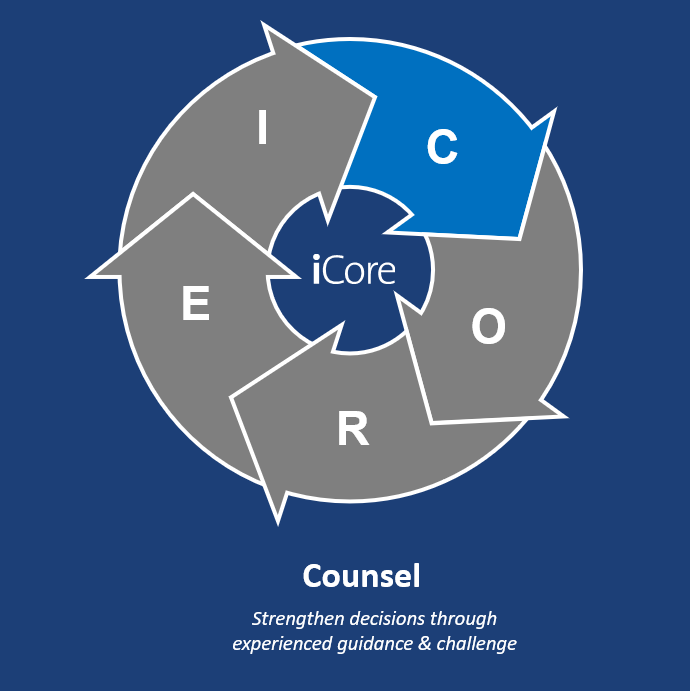
iCore and our consultants can help you identify your key value streams (most closely aligned with your organisation’s strategic goals) and work with you to map them out visually to facilitate identification of opportunities to improve those value streams. We undertake maturity assessments of the practice areas contributing to the value streams, and by doing this, we can identify opportunities to modernise those practice areas and the ways they interact, resulting in optimised value streams. We then present you with a roadmap for change to modernise how your organisation thinks and operates and help you embed and normalise these new ways of working and thinking.
We have been in business for 25 years and are helping companies and organisations across several market sectors to modernise their Service Management strategy and focus to be effective in a Digital, DevOps world.