Outsourcing – Managing the Transition of Services
Outsourcing, as we have talked about in some of our previous articles is experiencing significant growth on a global scale and this trend is showing no signs of slowing down. Numerous companies have recently entered or are about to enter into an outsourced agreement for the first time, which presents a big change to their current IT Service Delivery model, processes, and ways of working.
Introduction
Is outsourcing a wise decision? IT Service Delivery being handled by `the professionals` and the potential to exploit new delivery models and technologies are two of the main reasons why companies take this step. However, by not following good practice through the selection, onboarding, and cutover stages, many have ended up with agreements that are not fit for purpose.
In our previous blog post about the basics of outsourcing, we discussed the pros and cons of outsourcing, contract structures, and understanding the level of service you will receive so that there are no hidden surprises. Today, we discuss the transition to an outsourced service, the service cutover (when the new service goes live), and how getting the basics right will help set you up for short—and long-term success.
Key characteristics of a Transition Plan
You can never be too prepared when it comes to entering into an outsourced agreement, and following a thorough transition plan will help to mitigate any risks along the way. When contracts are signed and a cutover date is agreed, the outsourcer produces a transition plan describing how everything will be transitioned across to them. An effective transition plan includes the overall approach, the transition of people and assets, and communications to all key parties. It will also describe service level baselines and conditions for the cutover, i.e., when the service will fully come into effect.
Your company and outsourced partner need to manage several key aspects of the plan carefully and diplomatically. One of these is the transition of people, which in our experience can be one of the more challenging aspects of the transition. There will be different scenarios depending on the agreement you have signed; staff members from your company moving over to the outsourced partner, some leaving the company, and others being deployed into different roles. While some will see this as a positive move, others may believe they had no choice. Whatever the situation, it is important to handle it professionally, with empathy towards the individuals concerned, and involve your HR team at every step of the journey so that people get the support and direction they need.

Another key characteristic of a transition plan is the baselining of service levels. Without an agreed baseline of `what good will look like` and metrics to support it, you cannot measure your outsourcer’s performance. When transition activities are in full swing, it is important to have pre agreed service level metrics with your outsourcer that they can be held accountable to, both during the transition and for a period after the service cutover. Ensuring that expectations are clearly communicated and understood by all parties is essential, as you do not want individuals and teams to be confused about their role and what is expected.
Transition Delivery
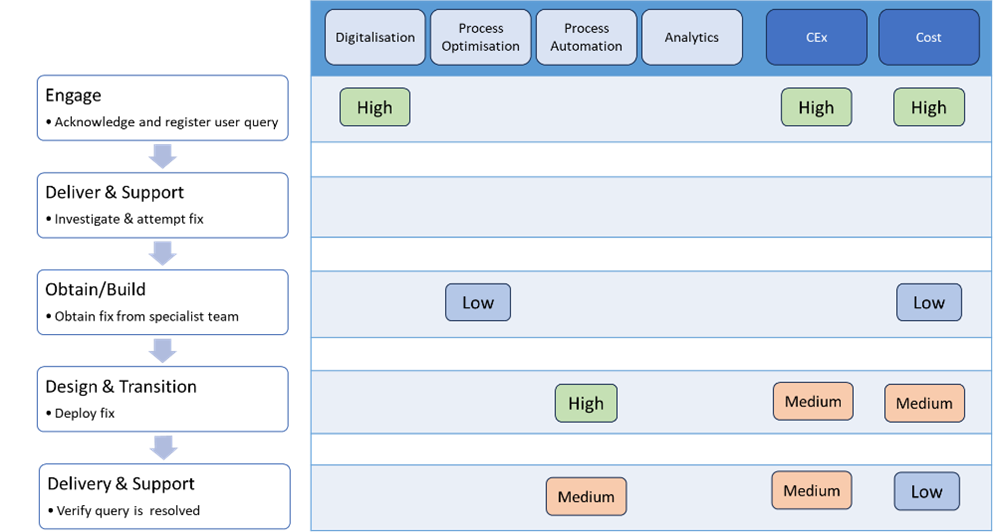
A Flexible Operating Model will need to continuously respond to the need for change in the ways of working across the teams delivering the products and services, and optimise its processes and supporting workflow to provide the flexibility necessary to adopt change.
Using Lean principles to ensure that processes can deliver their expected outcomes while reducing waste due to inefficiencies in the existing ways of working and taking advantage of the same technology shifts as the rest of the business is key to enabling a flexible model.
Reducing the number of unnecessary steps and bureaucracy in process flows, in conjunction with using digitalisation and automation technologies within these process flows, will support the ability to accept and manage change to the ways of working needed.

In todays complex IT world this means that the IT Operating model also must support multi-modal speeds of service and solution delivery through Waterfall and Agile styles of Project Management, while also encompassing multi-cloud service management and other shifts in technology, including supplier management and SIaM Ecosystems.
Importantly the ITOM supports building a common understanding of the IT organisations overall design and desired ways of working, allowing people to visualise how the organisation works from a variety of different perspectives across the value chain as every significant element of business activity should be layered against the model to ensure it is fit for purpose.
Increasing the use of automation within process flows does not reduce the need for these data points to be captured but will often require additional work in the automation platforms themselves to still update and present the data points in supply to the single source of truth for this data in the organisation.
Artifical Intelligence and Machine Learning
sMachine Learning and Generative AI technologies have been a significant inflection point leading change for many organisations.
According to a recent survey by McKinsey 1, one-third of their respondents said their organisations are using Generative AI regularly in at least one business function. This survey also revealed that 40% of its respondents stated that their organizations will increase their investment in AI overall because of advances in Generative AI. The expected business disruption from Generative AI is significant and will bring additional challenges to be embedded within a flexible operating model.

Low Code platforms and the rise of 'ciitizen development'
Low code platforms are empowering business users to be able to build their own digital solutions, Shell as an example has around 800 citizen developers in its manufacturing teams who have developed 75 DIY applications with 200 more in the development pipeline. 2
Once created like any other software-based solution there will be ongoing maintenance and security profiles to be maintained by the teams responsible for them, and in many cases, there will be integrations/interfaces created between these apps and existing line of business applications to be managed.
The proliferation of low code platforms has empowered “citizen developers”, enabling innovation throughout the organisation. The ITOM must deliver the appropriate controls & standards around the use of these platforms to realise the benefits and avoid a complex and difficult to maintain IT environment.
Managing the introduction of these DIY applications and the shared understanding of the support wrappers necessary for them in the operating model will be an area of focus for IT leadership to engage with the business units to empower them to further unlock benefits from these platforms while providing stable, reliable solutions.
Enterprise Service Management
The expansion of Service Management best practices into other service areas of the business, commonly referred to as Enterprise Service Management (ESM), has seen service management capabilities, previously part of IT’s back-office functions and costs, turned into a capability leverageable from the investments made in IT services across the wider operating model of the organisation.
The ability of Large Language Models and generative AI to enable individuals and organisation to meet increasing demands and provide a more attractive place to work by reducing mundane and manual tasks needs to be balanced against the ethical considerations in the use of these technologies.
Considerations for the introduction and use of these technologies and their governance requirements in areas such as data protection and privacy will need to drive clear policies for embedding across the operating model.
The current pace of change and adoption of these technologies is seen to be one of the largest driving factors for the need of a flexible operating model in IT organisations. For IT leadership these technologies could very well become the next generation of ‘shadow IT’ growth within organisations.
Managing Partner and Supplier Ecosystems
The Flexible Operating Model acknowledges that the modern Technology Department must rely on a multitude of suppliers and these suppliers need to be managed carefully to ensure that the business gets the best value from them all.
Where a supplier is a Tier 1 supplier, i.e., a strategic supplier / partner, then that supplier needs to be considered part of the Technology Department and be involved in the strategy, innovation and solution development in a way that is not just responding to a statement of work or request for purchase.
This is what makes it a true ecosystem, a community of components working together in an integrated way that makes best use of the strengths of the individual components whilst creating a single technology platform.
Effective management of the Sourcing Strategy (internal and external), Supplier Tiering (focus on value add not spend), Vendor Management (as an integrated purchasing, contract management and performance management capability), and Collaboration (within defined rules) all become essential aspects of governance.
SIaM is a framework that can support managing and orchestrating multiple vendors and suppliers of services as part of the overall operating model. The framework facilitates the adoption of service integration roles and activities for managing outcomes across these external organisations to ensure a coordinated IT organisation is seen to be providing the services.
Conclusion
IT leaders need to be able to continuously re-wire their IT structures, culture, policies, and processes that enable the delivery of effective, efficient, and economically viable products and services, delivered not only to their end customers but to the internal consumers as well.
A Flexible Operating Model will help the Business, IT organisation and its supplier ecosystem work together as a single entity while supporting the pace of change that is empowering organisations to move faster and innovate new solutions and services while safeguarding the ongoing need for reliable delivery of any existing services and solutions.
Ultimately, the adoption of a Flexible IT Operating Model will improve efficiency, deliver exceptional customer experience, reduce operating costs, and enhance business value.
In our experience no single body of knowledge, framework or toolset can answer these requirements of a modern IT organisation. Our Modern Service Management practices incorporated into a Flexible Operating Models blends our own consultants’ years of delivery experience with frameworks and standards such as ITIL®, CObIT®, IT4IT® and ISO to create flexible operating models that are tailored to support the evolving needs for delivering IT services within their organisations .
If you are interested in hearing more about iCore’s services and how we may be able to help you overcome your challenges, contact us using the button below.