Unified IT Ecosystem
Achieving Business Goals Through a Unified, High-Performing IT EcosystemIn a complex and interconnected business environment, achieving a unified IT ecosystem goes beyond technology; it requires alignment, collaboration, and a relentless focus on delivering value. iCore’s Unified IT Ecosystem framework centers on these three foundational pillars—Strategic Alignment, Collaborative Culture, and Value Stream Optimisation—to help organisations create a cohesive IT environment that drives business objectives forward.
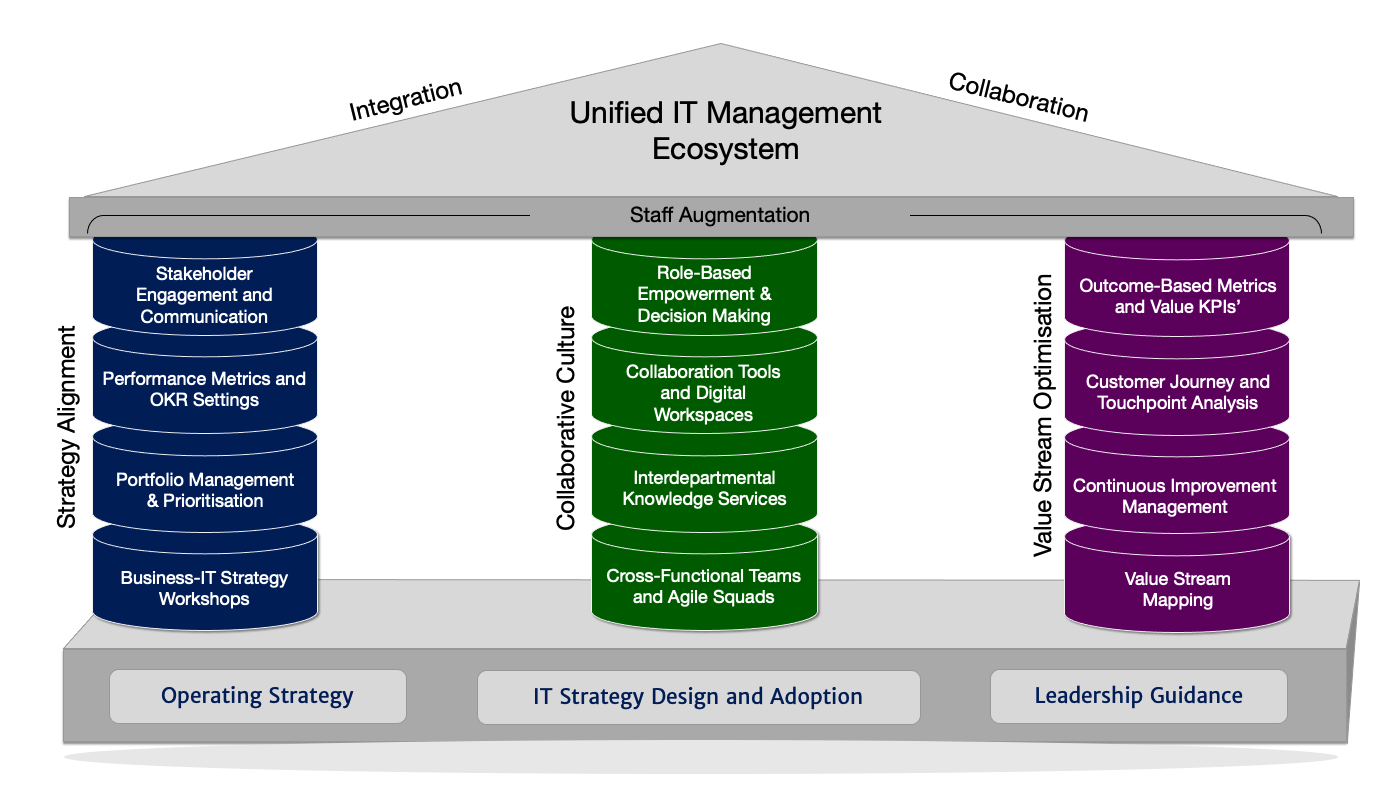
Three pillars of Unified IT Operations.
Strategic Alignment
Ensuring that IT initiatives are directly aligned with the organisation’s broader strategic goals.
Business-IT Strategy Workshops
Facilitate workshops that bring IT and business leaders together to identify shared priorities and align on key objectives.
- Objective: Establish a unified vision that positions IT as a strategic partner.
- Outcome: Aligned strategies that integrate IT into the core of the business, enhancing overall cohesion.
Portfolio Management and Prioritisation
Guide the organisation in managing its IT projects as part of a broader portfolio, prioritising those that drive the most value.
- Objective: Ensure IT resources are directed toward initiatives that support business growth.
- Outcome: A strategic, well-prioritised project portfolio that maximises impact and efficiency.
Performance Metrics and OKR Setting
Define measurable objectives and key results (OKRs) that align IT performance with business goals.
- Objective: Create clear metrics that demonstrate IT’s contribution to strategic objectives.
- Outcome: Enhanced accountability and transparency in IT’s impact on business outcomes.
Stakeholder Engagement & Communication
Establish regular communication channels with key stakeholders to maintain alignment and adaptability.
- Objective: Foster a shared understanding of IT’s role and ensure responsiveness to changing needs.
- Outcome: Improved collaboration and trust between IT and business functions, reinforcing strategic alignment.
Speak with an iCore Specialist
Get in touch with our team to discover how our Product Management framework can elevate your IT services and drive long-term value.
Start Your IT Service Transformation
From lifecycle management to customer experience and roadmapping, iCore has the expertise to bring your IT services to the next level. Let’s get started
Collaborative Culture
Breaking down silos to foster a culture of collaboration and shared responsibility across departments.
Cross-Functional Teams & Agile Squads
Develop agile teams that include members from multiple departments to enhance collaboration and drive innovation.
- Objective: Leverage diverse expertise for faster, more holistic problem-solving.
- Outcome: High-performing teams that deliver more comprehensive, adaptable solutions.
Interdepartmental Knowledge Sharing
Facilitate regular forums and tools for sharing knowledge and best practices across departments.
- Objective: Build a culture of shared learning and collaboration.
- Outcome: Reduced knowledge gaps and an empowered workforce that draws on collective insights.
Collaboration Tools and Digital Workspaces
Encourage the use of accessible collaboration practices and digital workspaces for team-based projects.
- Objective: Enhance connectivity and ensure efficient teamwork, even in distributed setups.
- Outcome: Seamless collaboration that transcends physical and departmental boundaries.
Role-Based Empowerment
Empower employees by clearly defining roles and enabling decision-making at appropriate levels.
- Objective: Foster a sense of ownership and accountability within cross-functional teams.
- Outcome: A more engaged workforce where individuals are empowered to make impactful decisions.
Related Insights
Want to know a bit more or dive a bit deeper, no better start than to look at the following.
Value Stream Optimisation
Optimising value streams to ensure that IT services deliver measurable value to customers and stakeholders.
Value Stream Mapping
Conduct detailed mapping exercises to identify, visualise, and eliminate inefficiencies in IT value streams.
- Objective: Create a clear understanding of how value flows through IT processes.
- Outcome: Optimised processes that reduce waste and improve the speed and quality of value delivery.
Continuous Improvement Initiatives
Establish a structured approach to continuous improvement, using feedback loops to refine IT processes iteratively.
- Objective: Instill a culture of agility and responsiveness to changing requirements.
- Outcome: Incremental improvements that enhance service quality, adaptability, and efficiency.
Customer Journey and Touchpoint Analysis
Analyse customer journeys and key touchpoints to ensure IT services are aligned with user needs and expectations.
- Objective: Shift IT’s focus towards end-user satisfaction and value.
- Outcome: Enhanced user experience, leading to higher satisfaction and loyalty.
Outcome-Based Metrics and Value KPIs
Develop metrics focused on outcomes rather than outputs, to better reflect IT’s contribution to organisational goals.
- Objective: Encourage a results-oriented approach that prioritises actual value delivery.
- Outcome: Metrics that align IT services with business objectives, reinforcing a value-driven culture.
Speak with an iCore Specialist
Get in touch with our team to discover how our Product Management framework can elevate your IT services and drive long-term value.
Start Your IT Service Transformation
From lifecycle management to customer experience and roadmapping, iCore has the expertise to bring your IT services to the next level. Let’s get started