
IT Product Management
Empowering IT Services to Drive Value Through Strategic Product ManagementAt iCore, we believe IT services should be more than just operational support—they should be dynamic products that deliver lasting value to your organisation and customers. Our Product Management framework transforms IT services into adaptable, customer-focused solutions that evolve with your business. Through structured Service Lifecycle Management, user-centered Customer Experience strategies, and meticulously planned Product Roadmaps, we ensure your IT services stay relevant, responsive, and resilient. Discover how our tailored approach enables your IT services to meet today’s demands and anticipate tomorrow’s opportunities.
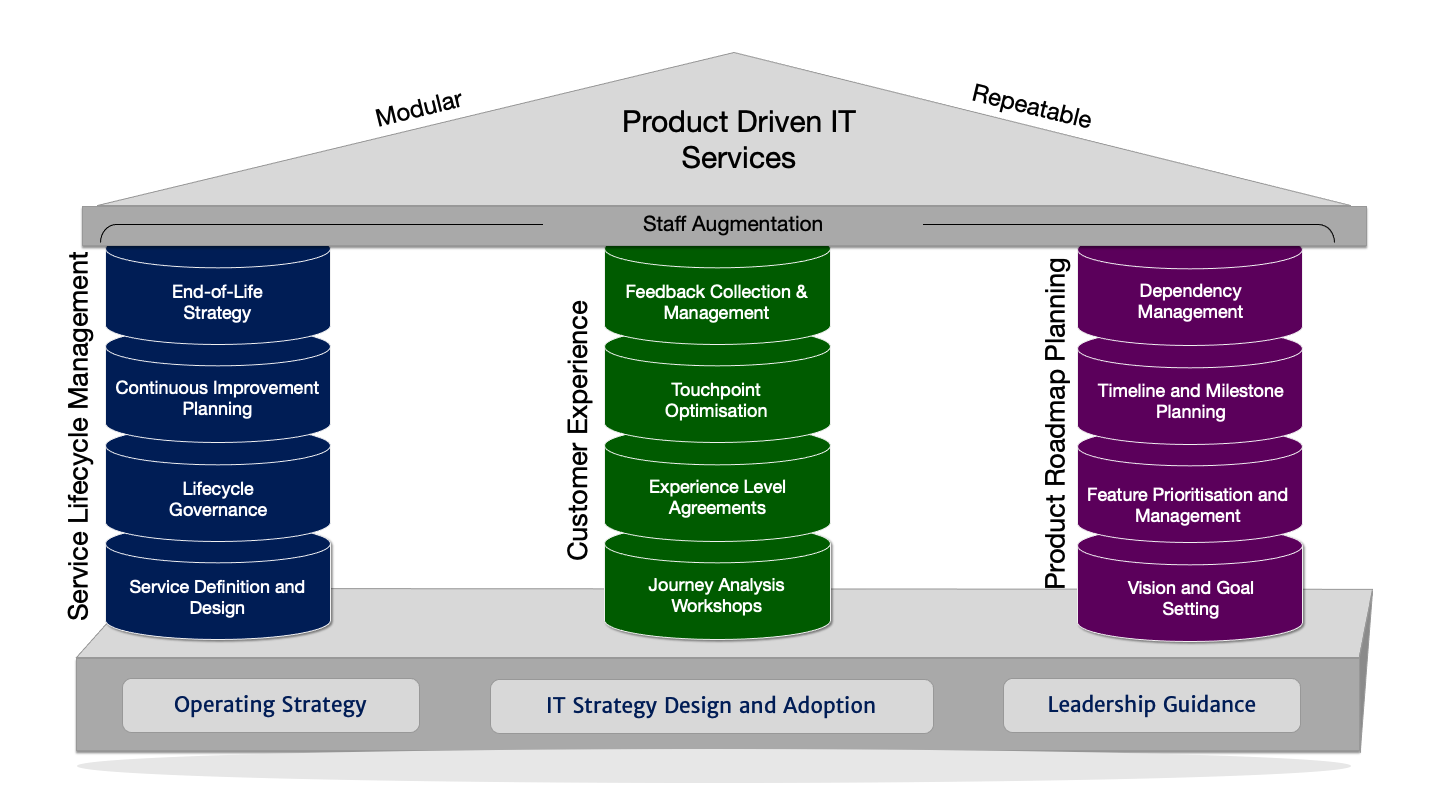
Three pillars of Product Management.
Service Lifecycle Management
Managing each stage of an IT service’s life to maintain relevance, value, and alignment with business objectives.
Key Deliverables and iCore’s Approach
Establishing a clear purpose, scope, and target audience is crucial in defining a successful IT service.
- Potential Challenges: Poorly defined services often lead to misaligned expectations, scope creep, and unclear success metrics, causing delays and customer dissatisfaction.
- iCore’s Approach: We collaborate with stakeholders through workshops to define and document a service’s core objectives, expected outcomes, and user personas. Our rigorous approach ensures a well-defined service that meets precise business needs and user expectations from the start.
Lifecycle Governance
This involves setting up policies, standards, and accountability mechanisms to manage each service stage effectively.
- Potential Challenges: Without clear governance, service quality can fluctuate, leading to inconsistent user experiences, inefficient resource use, and compliance risks.
- iCore’s Approach: iCore creates robust governance frameworks, embedding ITIL and COBIT principles to ensure services are delivered consistently and meet defined standards. This approach provides structure, enabling efficient management across service phases.
Continuous Improvement Planning
An iterative improvement process ensures services remain relevant and valuable over time.
- Potential Challenges: Without continuous improvement, services can stagnate, missing opportunities for enhancement or adaptation to changing needs, resulting in declining customer satisfaction.
- iCore’s Approach: We help organizations set up feedback loops, analytics tracking, and agile refinement cycles. This allows for data-driven improvements based on user feedback and performance metrics, fostering a culture of evolution and relevance.
End-of-Life Strategy
Managing service retirement ensures a seamless transition for users while optimizing resources.
- Potential Challenges: Neglecting end-of-life planning can lead to unsupported, outdated services that drain resources and create security vulnerabilities.
- iCore’s Approach: iCore develops structured, well-timed decommissioning plans to retire services smoothly, mitigating any negative impact on users and reallocating resources to more valuable initiatives.
Speak with an iCore Specialist
Get in touch with our team to discover how our Product Management framework can elevate your IT services and drive long-term value.
Start Your IT Service Transformation
From lifecycle management to customer experience and roadmapping, iCore has the expertise to bring your IT services to the next level. Let’s get started
Customer Experience
Designing services that align with end-user needs to maximise engagement, satisfaction, and loyalty.
Journey Analysis Workshops
Understanding user journeys helps tailor service interactions to address pain points and enhance satisfaction.
- Potential Challenges: Without analysing the customer journey, services may overlook key touchpoints or fail to address critical pain points, leading to poor engagement and abandonment.
- iCore’s Approach: We conduct interactive workshops to map the end-to-end journey of each service, identifying friction points and areas of improvement. This enables the design of user-centric services that engage users effectively.
Experience Level Agreements (XLAs)
XLAs measure success based on user satisfaction rather than solely on technical metrics.
- Potential Challenges: Traditional SLAs often miss critical experience factors, leading to a gap between service performance and user satisfaction.
- iCore’s Approach: iCore helps clients establish XLAs, focusing on user-centered metrics like ease of access, response time, and issue resolution. This shifts the focus from just meeting technical requirements to ensuring a positive user experience.
Touchpoint Optimisation
Optimising critical user interactions ensures each touchpoint is efficient and satisfying.
- Potential Challenges: Without optimised touchpoints, users may face frustrating interactions, creating a barrier to effective service usage.
- iCore’s Approach: Our team evaluates each touchpoint, suggesting improvements in accessibility, design, and speed, ensuring every interaction enhances the overall user experience.
Feedback Collection & Management
Systematic feedback collection allows continuous adaptation based on user insights.
- Potential Challenges: Without a structured feedback process, valuable insights can be lost, making it difficult to respond to user needs and preferences.
- iCore’s Approach: We design feedback mechanisms, from surveys to user forums, and provide strategies for managing and analysing feedback. This enables organisations to adapt services to fit evolving user expectations.
Related Insights
Want to know a bit more or dive a bit deeper, no better start than to look at the following.
Product Roadmap Planning
Establishing a clear, strategic plan for the development, release, and evolution of IT services.
Vision and Goal Setting
Defining a clear vision and goals provides direction and purpose for each service.
- Potential Challenges: Without a well-defined vision, services can become unfocused, leading to inconsistent feature development and misaligned resources.
- iCore’s Approach: iCore facilitates goal-setting workshops, aligning service objectives with business strategy and market trends. This ensures each service has a clear, attainable vision that supports long-term success.
Feature Prioritisation and Management
Identifying and prioritising features ensures resources are used effectively and that user needs are met.
- Potential Challenges: A lack of prioritisation can lead to feature overload, overwhelming users and stretching development resources thin.
- iCore’s Approach: Our structured feature prioritisation process, based on impact vs. feasibility matrices, ensures that only high-value features are developed. This method reduces scope creep and keeps development focused on what truly benefits users.
Timeline and Milestone Planning
Creating realistic timelines and milestones keeps service development on track.
- Potential Challenges: Without structured timeline planning, projects can face delays, impacting user adoption and trust.
- iCore’s Approach: We work collaboratively with clients to set clear, achievable timelines and milestones, facilitating efficient project management and transparent progress tracking.
Dependency Management
Managing dependencies prevents bottlenecks and ensures efficient workflow across service teams.
- Potential Challenges: Ignored dependencies can lead to delays, resource conflicts, and unexpected roadblocks.
- iCore’s Approach: Our approach to dependency management involves mapping and actively tracking interdependencies. This proactive method reduces risks and enables smoother project execution.
Speak with an iCore Specialist
Get in touch with our team to discover how our Product Management framework can elevate your IT services and drive long-term value.
Start Your IT Service Transformation
From lifecycle management to customer experience and roadmapping, iCore has the expertise to bring your IT services to the next level. Let’s get started