
Agile Service Management
The perfect mix of agility and governance to get you where you need to beIn today’s digital world, agility in IT service management is essential for staying responsive to evolving business needs and delivering exceptional customer experiences. iCore’s Agile Service Management framework reimagines traditional ITSM practices through the lens of agility, flexibility, and customer-centricity. By embedding modular and repeatable processes, we empower organisations to create adaptable IT services that align with business goals. This framework is built on three foundational pillars: Agile ITSM Transformation, Sprint-Based Processes, and DevOps and ITSM Integration.
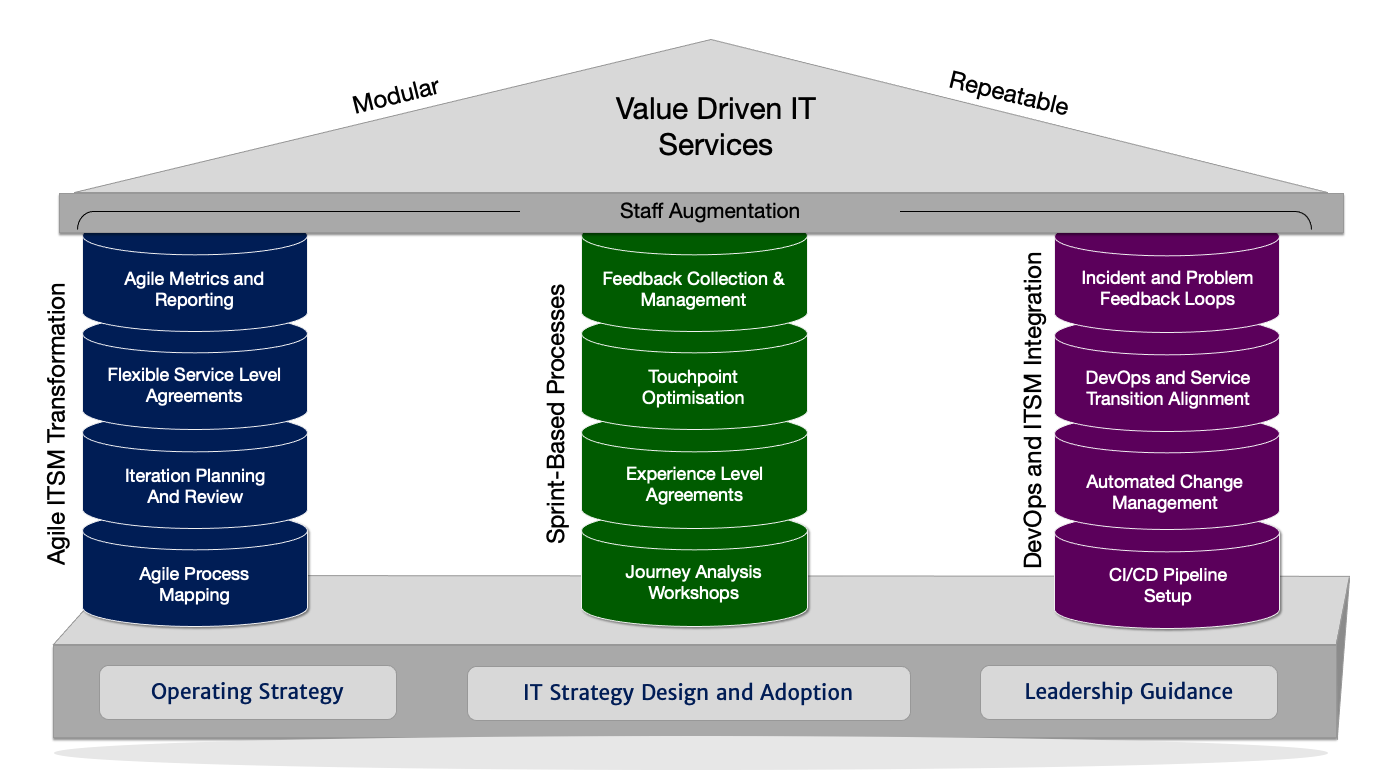
Three pillars of Agile Service Management.
Agile ITSM Transformation
Transforming traditional ITSM practices to enhance agility, responsiveness, and customer focus.
Agile Process Mapping
-
Agile Process Mapping:
Defining and visualizing ITSM processes through agile methodologies to streamline workflows and increase adaptability.- Potential Challenges: Without agile mapping, ITSM processes can become rigid, leading to slower response times and reduced flexibility.
- iCore’s Approach: iCore uses agile process mapping to foster flexibility in service delivery. By breaking down traditional silos and enabling cross-functional visibility, we ensure that ITSM processes remain responsive to change. This approach enables your teams to swiftly adjust workflows, aligning service management with evolving business needs and enhancing the agility of IT operations.
Iteration Planning and Review
Implementing iterative cycles to support continuous refinement of ITSM practices, with an emphasis on learning and adaptation.
- Potential Challenges: A lack of iterative planning can lead to stagnant processes, missing opportunities for improvement and efficiency.
- iCore’s Approach: We facilitate iteration planning and review sessions, where teams evaluate performance after each cycle, gather feedback, and adjust accordingly. This iterative structure promotes a culture of continuous improvement, ensuring ITSM processes stay efficient, relevant, and aligned with user expectations. Our approach enhances responsiveness and embeds agility within the ITSM framework.
Flexible Service Level Agreements
Developing adaptable SLAs that evolve with service requirements and focus on customer outcomes.
- Potential Challenges: Rigid SLAs can restrict IT service agility, preventing ITSM from meeting dynamic customer expectations.
- iCore’s Approach: We design flexible SLAs centered on user outcomes and business priorities. This adaptability enables SLAs to shift as business needs change, ensuring that service agreements support both operational requirements and user satisfaction. Our approach aligns SLAs with the principles of agile service management, keeping services responsive to changing demands.
Agile Metrics and Reporting
Implementing agile-specific metrics to track ITSM performance, fostering transparency and accountability.
- Potential Challenges: Without agile metrics, it’s challenging to measure ITSM’s impact on responsiveness and customer satisfaction.
- iCore’s Approach: iCore establishes agile metrics and reporting that focus on velocity, throughput, and user satisfaction. By tracking these key performance indicators (KPIs), we provide actionable insights into ITSM performance and areas for improvement. This focus on metrics ensures that agile service management objectives, like responsiveness and user-centricity, are achieved consistently.
Speak with an iCore Specialist
Get in touch with our team to discover how our Product Management framework can elevate your IT services and drive long-term value.
Start Your IT Service Transformation
From lifecycle management to customer experience and roadmapping, iCore has the expertise to bring your IT services to the next level. Let’s get started
Sprint-Based Processes
Embedding sprint cycles to drive iterative improvements and maintain alignment with user expectations.
Journey Analysis Workshops
Understanding user journeys helps tailor service interactions to address pain points and enhance satisfaction.
- Potential Challenges: Without analysing the customer journey, services may overlook key touchpoints or fail to address critical pain points, leading to poor engagement and abandonment.
- iCore’s Approach: We conduct interactive workshops to map the end-to-end journey of each service, identifying friction points and areas of improvement. This enables the design of user-centric services that engage users effectively.
Experience Level Agreements (XLAs)
XLAs measure success based on user satisfaction rather than solely on technical metrics.
- Potential Challenges: Traditional SLAs often miss critical experience factors, leading to a gap between service performance and user satisfaction.
- iCore’s Approach: iCore helps clients establish XLAs, focusing on user-centered metrics like ease of access, response time, and issue resolution. This shifts the focus from just meeting technical requirements to ensuring a positive user experience.
Touchpoint Optimisation
Optimising critical user interactions ensures each touchpoint is efficient and satisfying.
- Potential Challenges: Without optimised touchpoints, users may face frustrating interactions, creating a barrier to effective service usage.
- iCore’s Approach: Our team evaluates each touchpoint, suggesting improvements in accessibility, design, and speed, ensuring every interaction enhances the overall user experience.
Feedback Collection & Management
Systematic feedback collection allows continuous adaptation based on user insights.
- Potential Challenges: Without a structured feedback process, valuable insights can be lost, making it difficult to respond to user needs and preferences.
- iCore’s Approach: We design feedback mechanisms, from surveys to user forums, and provide strategies for managing and analysing feedback. This enables organisations to adapt services to fit evolving user expectations.
Related Insights
Want to know a bit more or dive a bit deeper, no better start than to look at the following.
DevOps and ITSM Integration
Integrating DevOps principles with ITSM for seamless service transitions, automation, and collaboration.
CI/CD Pipeline Setup
Implementing Continuous Integration and Continuous Deployment (CI/CD) pipelines to streamline service releases.
- Potential Challenges: Without CI/CD, service updates can be slow and prone to errors, disrupting agility.
- iCore’s Approach: iCore establishes CI/CD pipelines that allow for automated, reliable service releases. By enabling frequent and efficient deployments, we ensure that ITSM processes support the agile principles of speed and adaptability.
Automated Change Management
Automating routine changes to minimize manual intervention, reducing errors and increasing efficiency.
- Potential Challenges: Manual change processes can be slow, introducing delays and inconsistencies.
- iCore’s Approach: We implement automated change management practices, using tools that automate approvals for low-risk changes. This approach reduces delays and allows your team to focus on high-value tasks, supporting a more agile and responsive ITSM process.
DevOps and Service Transition Alignment
Aligning DevOps and service transition processes to ensure seamless integration and delivery.
- Potential Challenges: Misaligned DevOps and ITSM practices can create bottlenecks and hinder agile progress.
- iCore’s Approach: iCore bridges the gap between DevOps and ITSM by aligning workflows, ensuring that code development and service transition are well-coordinated. This alignment fosters a collaborative environment, enabling IT services to be agile, reliable, and scalable.
Incident and Problem Feedback Loops
Establishing feedback loops between DevOps and ITSM to improve incident and problem resolution.
- Potential Challenges: Lack of feedback between DevOps and ITSM teams can result in recurring issues and slower incident resolution.
- iCore’s Approach: We create structured feedback loops that facilitate continuous learning between DevOps and ITSM teams. This collaboration allows for faster incident resolution and root cause analysis, embedding continuous improvement into incident management practices.
Speak with an iCore Specialist
Get in touch with our team to discover how our Product Management framework can elevate your IT services and drive long-term value.
Start Your IT Service Transformation
From lifecycle management to customer experience and roadmapping, iCore has the expertise to bring your IT services to the next level. Let’s get started